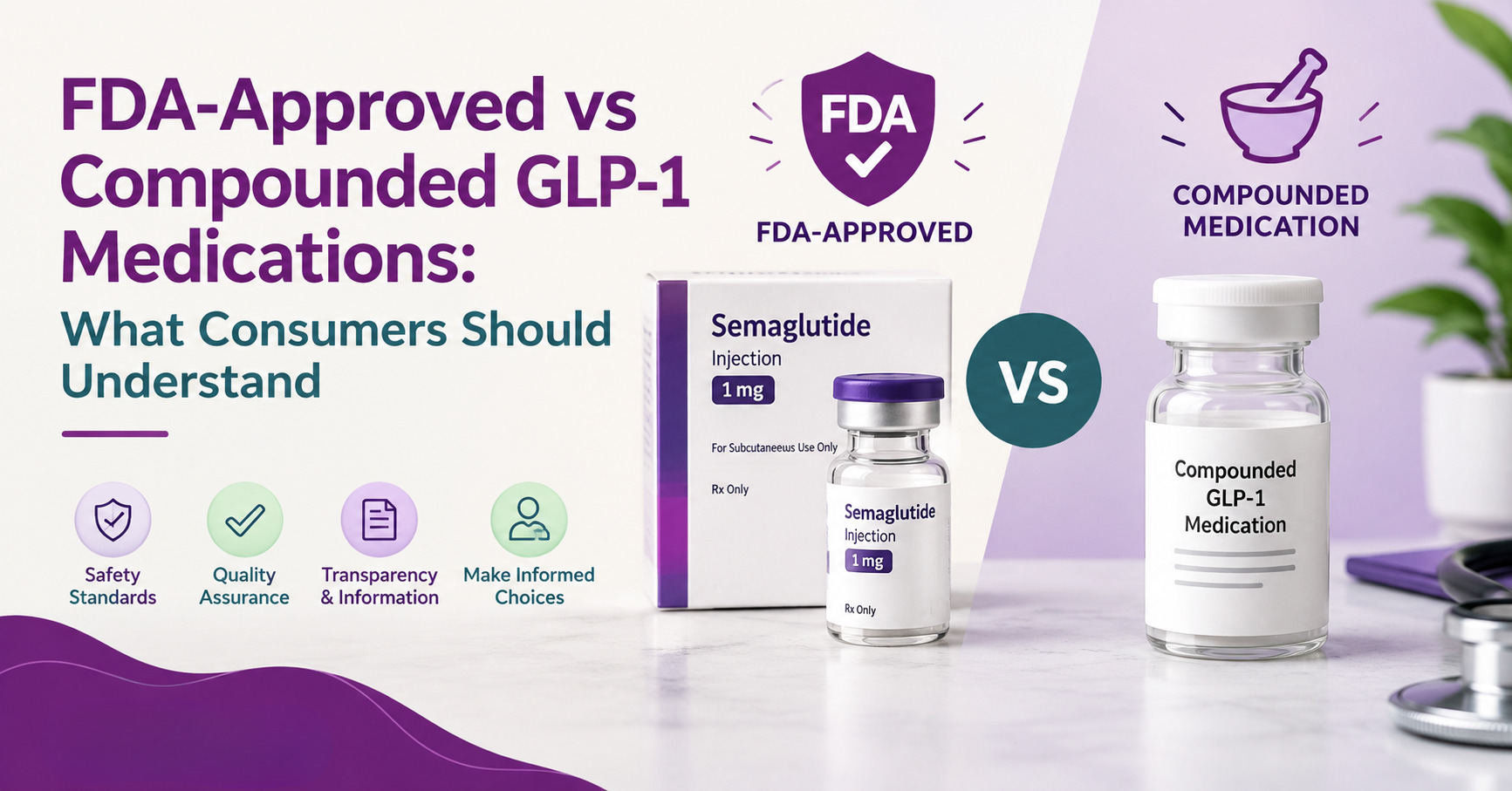
FDA-approved medicines are reviewed for safety, effectiveness and manufacturing quality before approval. Compounded drugs are not FDA-approved, and FDA does not verify their safety, effectiveness or quality before they are marketed. Compounding can serve specific patient needs, but it is not the same as generic-drug approval or brand approval.
This article is for general educational information and is not a substitute for diagnosis, prescribing, dosing or individualized medical advice. Semaglutide is a prescription medicine. Product indications and instructions differ by formulation. Readers should use the exact current prescribing information and speak with a licensed healthcare professional. |
What FDA approval means
An FDA-approved medicine has gone through an approval process that evaluates evidence for safety and effectiveness and establishes manufacturing and labeling requirements. The approved product has a defined formulation, strength, indication and prescribing information.
This does not mean an approved drug has no risk; it means the risks and benefits have been evaluated through the regulatory process.
What compounding means
Compounding is the preparation of a medication for a patient under specific circumstances. FDA explains that compounded drugs are not FDA-approved and that the agency does not verify safety, effectiveness or quality before they are marketed.
Compounded drugs are also not the same as FDA-approved generic medicines.
Why GLP-1 compounding has received attention
During shortages, compounded GLP-1 products became widely marketed. FDA has since clarified compounding policy as supply stabilized and has taken action against misleading claims involving non-FDA-approved compounded GLP-1 products.
Consumers should be especially cautious when marketing suggests a compounded product is a direct, approved equivalent.
Dosing and measurement can create extra risk
FDA has reported adverse events, including hospitalizations, associated with dosing errors involving compounded injectable semaglutide. Problems included patients measuring incorrect amounts and healthcare professionals miscalculating doses.
Vial concentrations and syringe units can create confusion that does not exist with every prefilled approved product.
When compounding may be appropriate
FDA notes that compounded drugs can have a role when an FDA-approved drug cannot meet a patient’s medical needs. That is different from mass-marketing a compounded product as a cheaper clone.
The decision should involve a licensed prescriber and an appropriately regulated pharmacy or outsourcing facility.
Frequently Asked Questions
Are compounded semaglutide products FDA-approved?
No. FDA states that compounded drugs are not FDA-approved.
Is a compounded drug the same as a generic drug?
No. FDA-approved generics meet specific approval requirements; compounded drugs do not go through that approval process.
Why has FDA warned about compounded semaglutide?
FDA has reported dosing errors and has taken action against misleading marketing of non-FDA-approved compounded GLP-1 products.
Can compounded medication ever be appropriate?
Yes, it can serve specific patient needs when an FDA-approved drug cannot meet them, under applicable compounding laws and clinical oversight.