
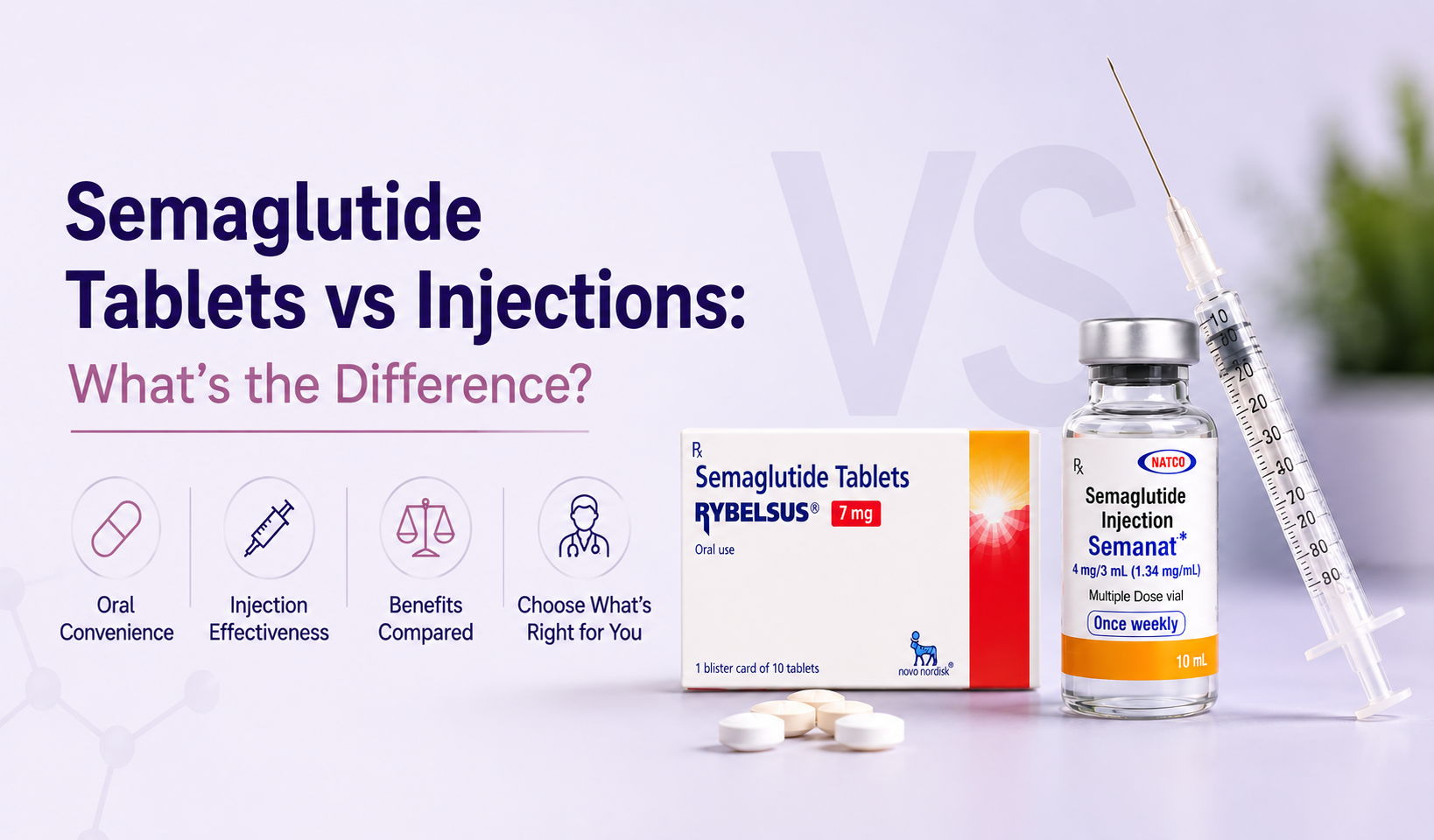
Semaglutide tablets and injections contain the same active ingredient but are not interchangeable. Oral absorption is very different from subcutaneous injection, and products can have different FDA-approved uses, strengths and schedules. Rybelsus 3 mg, 7 mg and 14 mg tablets are not the same product as Wegovy weight-management formulations.
Medical information note This article is for general educational information and is not a substitute for diagnosis, prescribing, dosing or individualized medical advice. Semaglutide is a prescription medicine. Product indications and instructions differ by formulation. Readers should use the exact current prescribing information and speak with a licensed healthcare professional. |
Same active ingredient does not mean same product
Oral and injectable semaglutide share the active ingredient, but the body receives them differently. A subcutaneous injection bypasses the digestive tract. An oral tablet must be formulated so that some semaglutide can be absorbed through the stomach, and its instructions are designed around that challenge.
This is the most important comparison point because it prevents a common mistake: comparing milligrams across formulations as if they were equivalent. They are not.
Approved uses can differ
Rybelsus 3 mg, 7 mg and 14 mg tablets are labeled for type 2 diabetes. Current Wegovy labeling covers chronic weight management using specific injectable and oral formulations. The newer Wegovy tablets use different strengths from Rybelsus. A product’s indication comes from its exact FDA labeling, not simply from the presence of semaglutide.
For website content, this distinction should be stated clearly anywhere oral products are discussed alongside weight loss.
Administration routines are different
Injection regimens can be weekly, depending on the product. Oral semaglutide products are taken daily and can have specific instructions regarding an empty stomach, water and the timing of food, beverages and other oral medicines. Those instructions exist because oral absorption can be sensitive to how the medicine is taken.
Convenience is personal. Some people prefer a tablet, while others prefer a once-weekly injection. The clinically appropriate option depends on the approved indication, health history, tolerability and prescriber recommendation.
Absorption and variability
Oral semaglutide has lower and more variable bioavailability than injected semaglutide. Current labeling for oral Wegovy notes greater variability in semaglutide blood concentrations with tablets. That is another reason not to treat a tablet dose as a direct substitute for an injection dose.
If a person is not responding as expected, the answer is not to improvise a switch. The prescriber should evaluate adherence, administration technique, other medicines, tolerability and whether a different approved treatment is appropriate.
Safety themes overlap
Because both formulations deliver semaglutide, they share important safety themes, including gastrointestinal effects and warnings specific to semaglutide products. But formulation-specific instructions and drug-interaction considerations can differ.
Anyone comparing options should ask two questions first: What exact product is this? What is it FDA-approved to treat? Those questions are more useful than asking whether a pill is ‘stronger’ than a shot.
Frequently Asked Questions
Are semaglutide tablets and injections the same dose?
No. Milligram strengths cannot be compared directly across oral and injectable formulations.
Is Rybelsus approved for weight loss?
Rybelsus 3 mg, 7 mg and 14 mg is labeled for type 2 diabetes, not as the same weight-management product as Wegovy.
Is there an oral form of Wegovy?
Current U.S. Wegovy labeling includes an oral tablet formulation for weight reduction in adults, with strengths different from Rybelsus.
Which is better, semaglutide tablets or injections?
There is no universal answer. The appropriate formulation depends on indication, medical history, tolerability, routine and prescriber guidance.