
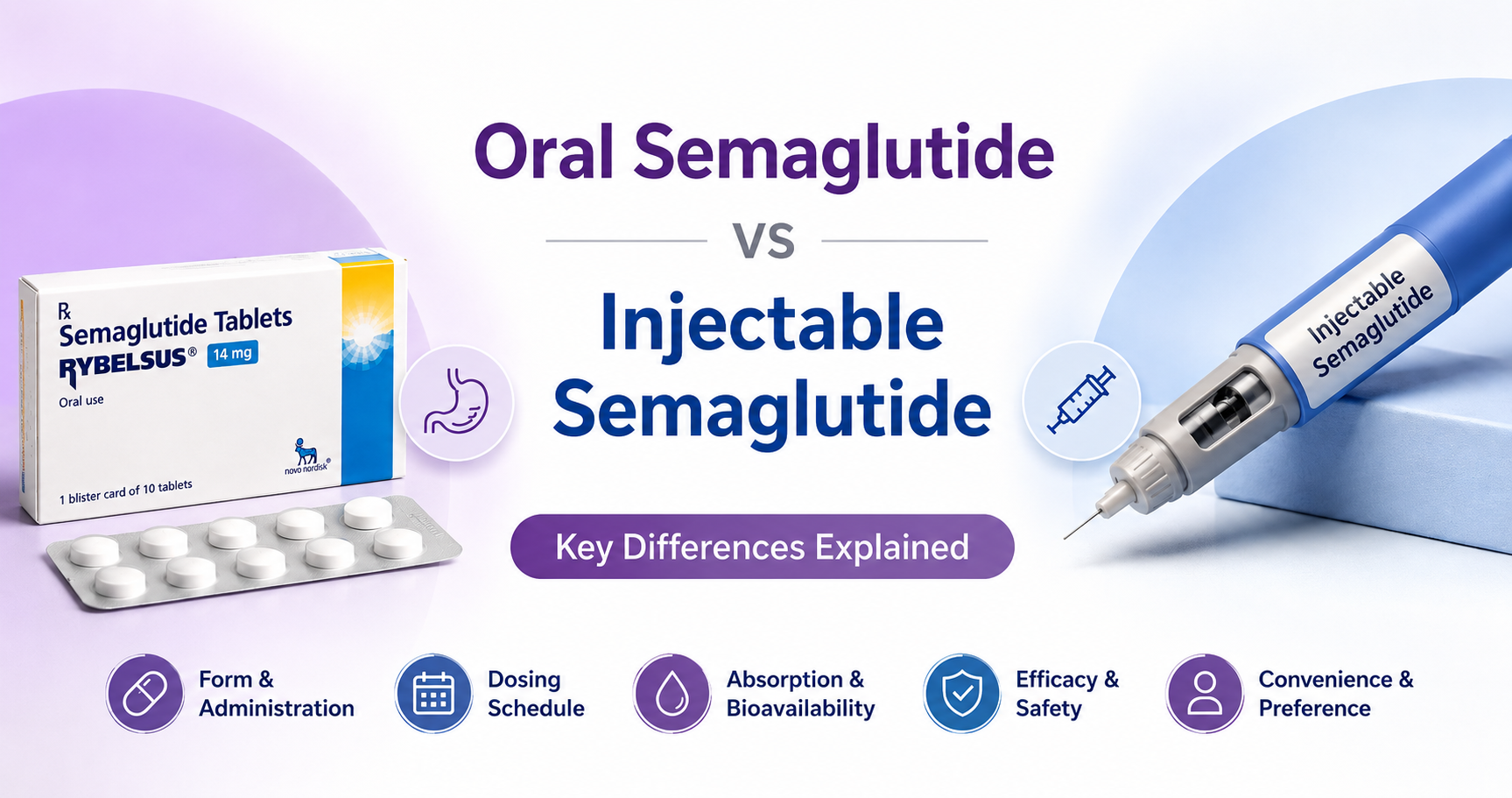
Oral and injectable semaglutide use the same active ingredient but deliver it differently. Tablets rely on gastrointestinal absorption and usually require specific timing instructions, while injections deliver semaglutide under the skin. Product indications and strengths also differ, so switching should only happen under a prescriber’s direction.
Medical information note This article is for general educational information and is not a substitute for diagnosis, prescribing, dosing or individualized medical advice. Semaglutide is a prescription medicine. Product indications and instructions differ by formulation. Readers should use the exact current prescribing information and speak with a licensed healthcare professional. |
The route changes how the medicine reaches the body
Injectable semaglutide is delivered into subcutaneous tissue, where it is absorbed into circulation. Oral semaglutide must survive and cross the gastrointestinal environment, so the formulation and administration instructions are designed to improve absorption.
That pharmacology difference explains why equal-looking milligram numbers do not represent equal exposure.
Daily routine versus weekly routine
Many injectable semaglutide products are dosed weekly. Oral semaglutide products are taken daily. For some people, a weekly routine is easier to remember; for others, taking a tablet fits naturally into a morning routine.
Adherence is not just preference, though. Oral products may need to be taken on an empty stomach with a limited amount of water and followed by a waiting period before food, drink or other oral medicines. People with complex morning medication schedules should discuss that with a pharmacist or prescriber.
The label matters more than the format
A tablet is not automatically a weight-management tablet, and an injection is not automatically the same as Wegovy. Current U.S. labels distinguish Rybelsus, Ozempic and Wegovy products even when semaglutide is the active ingredient.
The safest way to compare options is by exact product name, indication, formulation and prescribing information.
Side effects and monitoring
Gastrointestinal symptoms are common across semaglutide formulations. Nausea, vomiting, diarrhea, constipation and abdominal discomfort can occur. There are also important warnings and contraindications that require medical review.
Oral semaglutide can also be relevant to the absorption of other oral medicines because semaglutide delays gastric emptying and oral administration has its own timing requirements.
Questions to ask before choosing a formulation
Ask whether the exact product is approved for your treatment goal, how it fits with other medicines, what administration steps are required, what side effects should trigger a call, and what follow-up will be used to judge benefit.
That conversation is more reliable than choosing based on needle preference, price alone or a product page that groups every semaglutide formulation under one category.
Frequently Asked Questions
Can I switch from oral semaglutide to an injection myself?
No. Switching products can involve different strengths and schedules. It should be directed by a prescriber.
Why does oral semaglutide have special timing instructions?
Oral absorption is limited and sensitive to how the medicine is taken, so product instructions are designed to support consistent absorption.
Do tablets cause fewer side effects than injections?
Not necessarily. Both can cause gastrointestinal effects, and individual tolerability varies.
Are all oral semaglutide tablets for weight loss?
No. Check the exact product label. Rybelsus strengths are labeled for type 2 diabetes, while Wegovy has separate weight-management labeling.